
CTD-ILD

CTD-ILD en PPF
Patiënten met bindweefselziekten lopen het risico op het ontwikkelen van interstitiële longziekten (ILD).1,2
ILD zijn veelvoorkomende manifestaties die zich vaak vroeg in het verloop van auto-immuun-of bindweefselziekten (CTD) kunnen voordoen en kunnen zich ontwikkelen tot progressieve pulmonale fibrose (PPF).1,2
Risico op mortaliteit.
Zodra de ziekte progressief wordt, hebben patiënten met CTD-ILD een hoog risico op overlijden.9
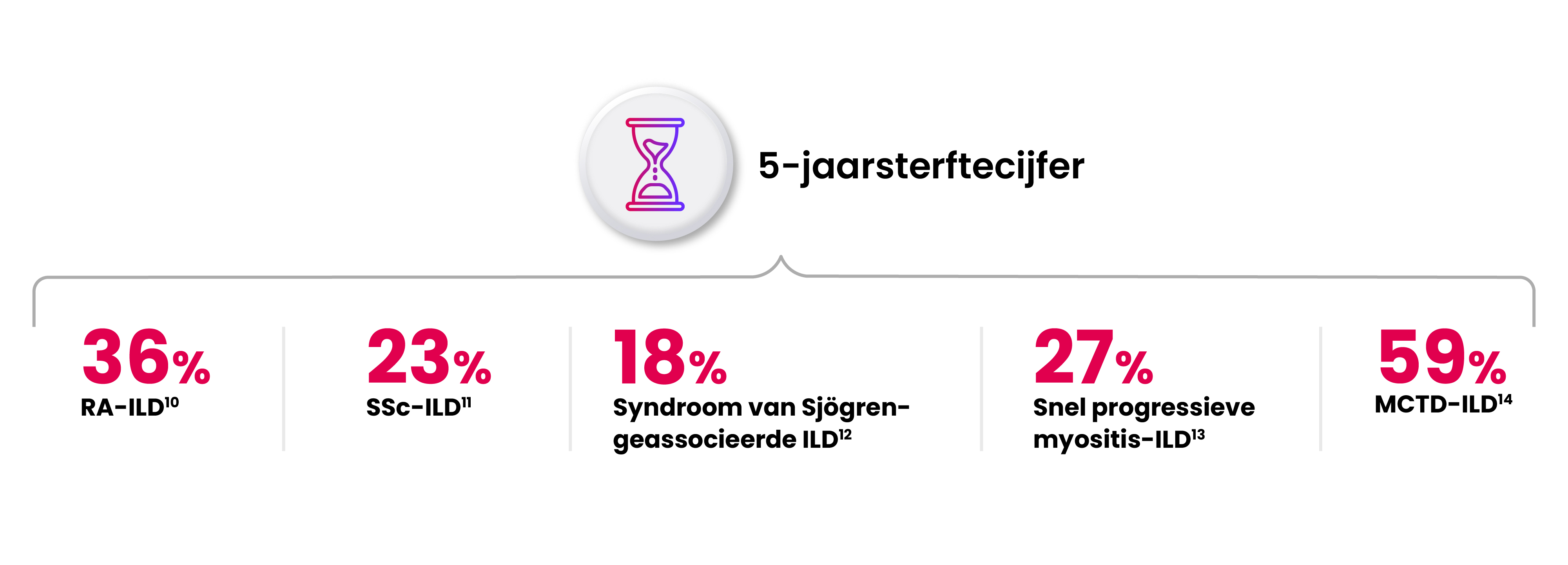
MCTD, mixed connective tissue disease RA, reumatoïde artritis; SSc, systemische sclerose.
Welke patiënten verdienen extra aandacht?
CTD-ILD omvat een heterogene groep bindweefselziekten
CTD-ILD is geen afzonderlijke aandoening, maar een verzamelnaam voor interstitiële longziekten die voorkomen bij verschillende bindweefselziekten. De presentatie, het ziekteverloop en het risico op progressie kunnen tussen patiënten sterk verschillen.18,19
De prevalentie van ILD verschilt per bindweefselziekte.20-23

Niet iedere patiënt volgt hetzelfde ziekteverloop
Het klinisch beloop van CTD-ILD is heterogeen. Sommige patiënten vertonen gedurende langere tijd een stabiel ziektebeeld, terwijl anderen een progressief fibrotisch ziekteverloop ontwikkelen. Progressie kan optreden ongeacht de onderliggende bindweefselziekte en wordt niet altijd vroegtijdig herkend.4,24,25
Daarom verdienen patiënten met CTD-ILD blijvende aandacht, ook wanneer de onderliggende reumatische aandoening onder controle lijkt.11,15,17
Waarom blijft vroege herkenning een uitdaging?
Ziekteprogressie is niet altijd voorspelbaar
CTD-ILD kent een variabele presentatie. Symptomen, radiologische afwijkingen en snelheid van progressie kunnen sterk verschillen tussen patiënten. Hierdoor kan het lastig zijn om patiënten te identificeren die risico lopen op een progressief fibrotisch ziekteverloop.24,25
Vroege symptomen zijn vaak aspecifiek
Vroege symptomen van ILD, zoals hoesten en dyspneu, zijn vaak aspecifiek en kunnen de diagnose voorafgaan.24,26 Hierdoor kan ziekteherkenning worden vertraagd.5-12
Vroege signalen en symptomen van ILD zijn vaak aspecifiek en kunnen de diagnose voorafgaan.26-31

Longbetrokkenheid kan zich vroeg in het ziekteverloop manifesteren
Bij patiënten met bindweefselziekten kan longbetrokkenheid zich vroeg in het ziekteverloop voordoen. Ontstekings- en fibrotische processen kunnen bovendien gelijktijdig aanwezig zijn, waardoor ziekteactiviteit niet altijd volledig zichtbaar is op basis van symptomen alleen.18,29,30
Structurele monitoring blijft daarom belangrijk
Omdat progressie van fibrose kan optreden ondanks verschillen in onderliggende aandoeningen en klinische presentatie, zijn regelmatige beoordeling van symptomen, longfunctie en beeldvorming belangrijke onderdelen van de follow-up van patiënten met CTD-ILD.15,17,31
HET DETECTEREN VAN PROGRESSIE
PPF wordt gedefinieerd als het optreden van ten minste 2 van de 3 criteria in het afgelopen jaar zonder alternatieve verklaring.5-8
Progressie kan worden vastgesteld aan de hand van klinische, radiologische en fysiologische veranderingen.5-8


DLCO, diffusiecapaciteit voor koolmonoxide; FVC, geforceerde vitale capaciteit.
Vroege detectie begint met structurele screening
Afwezigheid van symptomen sluit ILD niet uit
Een normale longfunctie of de afwezigheid van symptomen sluit ILD niet uit.24 Een HRCT blijft noodzakelijk om de diagnose ILD definitief te stellen of uit te sluiten.25
Hanteer HRCT als standaard voor ILD-screening bij SSc, MCTD en IIM; bij RA en SjD bepaalt het risicoprofiel de noodzaak tot screening.25

Screening van alle patienten met hoog risico is cruciaal voor vroege detectie en behandeling.15,16

Identificeer hoogrisicopatiënten door te screenen op ILD-risicofactoren.

Screen hoogrisico ILD-patiënten met HRCT's en PFT's om een baseline vast te stellen.17

Monitor op ILD-progressie met HRCT's, PFT's en saturatietesten.16,17
HRCT, high-resolution computed tomography; PFT, longfunctieonderzoek.
Help uw CTD-ILD-patiënten met PPF om hun ziekte onder controle te houden met een nieuwe, bewezen behandeloptie
CTD-ILD kan leiden tot progressieve pulmonale fibrose (PPF).¹⁻²⁸ Voor patiënten die PPF ontwikkelen, blijft behoefte bestaan aan nieuwe behandelstrategieën.5,15,17
Met preferentiële PDE4B-remming biedt JASCAYD® een nieuwe benadering voor patiënten met PPF.32-34

|
JASCAYD®: een nieuwe benadering voor patiënten met PPF.32-34
Samenvatting
CTD-ILD is een veelvoorkomende manifestatie van bindweefselziekten.1,2
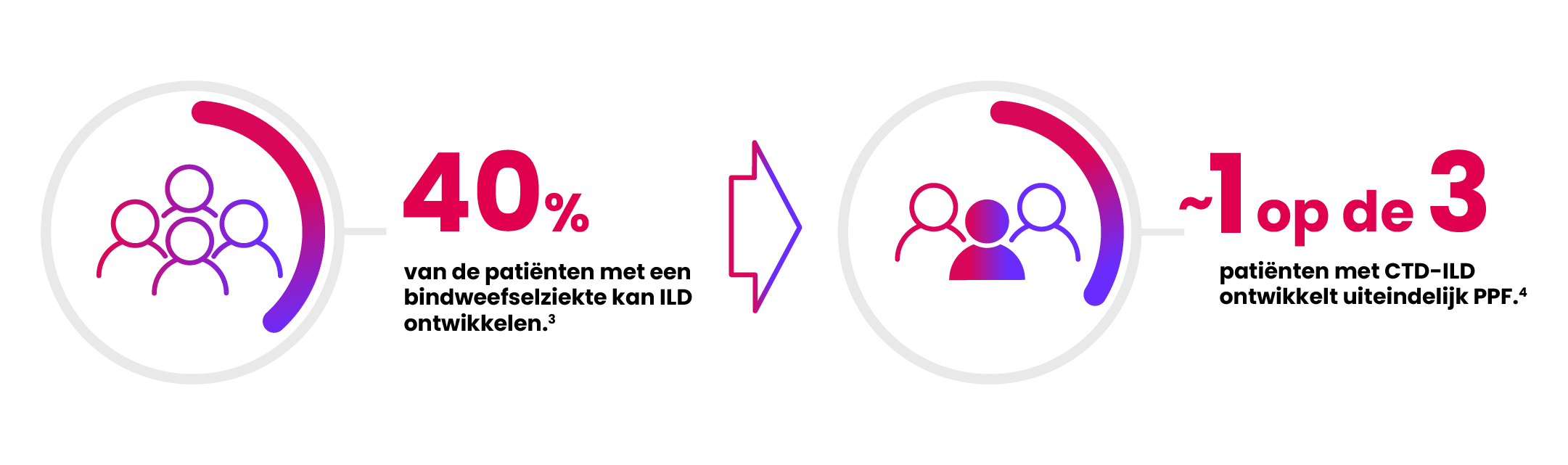
Tot 40% van de patiënten met een bindweefselziekte kan ILD ontwikkelen.3
Ongeveer 1 op de 3 patiënten met CTD-ILD ontwikkelt uiteindelijk PPF.4
Progressieve ziekte gaat gepaard met een verhoogd risico op mortaliteit.9-14
De presentatie, het ziekteverloop en het risico op progressie kunnen sterk verschillen tussen patiënten.18,19,24-31
Vroege herkenning, screening en monitoring blijven essentieel.15-17
Referenties
-
Wallace B, Vummidi D, Khanna D. Management of connective tissue diseases associated interstitial lung disease: a review of the published literature. Curr Opin Rheumatol.
-
Wells AU, Denton CP. Interstitial lung disease in connective tissue disease—mechanisms and management. Nat Rev Rheumatol. 2014;10(12):728-739.
-
Podolanczuk AJ, Hunninghake GM, Wilson KC, et al. Approach to the evaluation and management of interstitial lung abnormalities: an official American Thoracic Society clinical statement. Am J Respir Crit Care Med. 2025;211(7):1132-1155.
-
Wijsenbeek M, Kreuter M, Olson A, et al. Progressive fibrosing interstitial lung diseases: current practice in diagnosis and management. Curr Med Res Opin.
-
Raghu G, Remy-Jardin M, Richeldi L, et al. Idiopathic pulmonary fibrosis (an update) and progressive pulmonary fibrosis in adults. An Official ATS/ERS/JRS/ALAT Clinical Practice Guideline. Am J Respir Crit Care Med.
-
Kolb M, Vašáková M. The natural history of progressive fibrosing interstitial lung diseases. Respir Res. 2019;20(1):57.
-
Swigris JJ, Brown KK, Abdulgawi R, et al. Patients’ perceptions and patientreported outcomes in progressive-fibrosing interstitial lung diseases. Eur Respir Rev.
-
Reichmann WM, Yu YF, Macaulay D, Wu EQ, Nathan SD. Change in forced vital capacity and associated subsequent outcomes in patients with newly diagnosed idiopathic pulmonary fibrosis. BMC Pulm Med. 2015;15:167.
-
Kolb M, Bondue B, Pesci A, et al. Acute exacerbations of progressive-fibrosing interstitial lung diseases. Eur Respir Rev. 2018;27:180071.
-
Raimundo K, Solomon JJ, Olson AL, et al. Rheumatoid arthritis-interstitial lung disease in the United States: prevalence, incidence, and healthcare costs and mortality. J Rheumatol. 2019;46(4):360-369.
-
Su R, Bennett M, Jacobs S, et al. An analysis of connective tissue diseaseassociated interstitial lung disease at a US tertiary care center: better survival in patients with systemic sclerosis. J Rheumatol. 2011;38(4):693-701.
-
Pang R, Ma X, Guo H, Qi X. Meta-analysis of mortality-associated factors in primary Sjögren's syndrome patients with interstitial lung disease. Clin Rheumatol.
-
Li Y, Gao X, Li Y, et al. Predictors and mortality of rapidly progressive interstitial lung disease in patients with idiopathic inflammatory myopathy: a series of 474 patients. Front Med (Lausanne). 2020;7:363.
-
Nasser M, Larrieu S, Boussel L, et al. Estimates of epidemiology, mortality and disease burden associated with progressive fibrosing interstitial lung disease in France (the PROGRESS study). Respir Res. 2021;22(162):162.
-
Castelino FV, Moua T. Detection and management of interstitial lung diseases associated with connective tissue diseases. ACR Open Rheum. 2021;3(5):295-304.
-
Johnson SR, Bernstein EJ, Bolster MB, et al. 2023 American College of Rheumatology (ACR)/American College of Chest Physicians (CHEST) Guideline for the Treatment of Interstitial Lung Disease in People with Systemic Autoimmune Rheumatic Diseases. Arthritis Care Res (Hoboken).
-
Antoniou KM, Distler O, Gheorghiu A-M, et al. ERS/EULAR clinical practice guidelines for connective tissue disease-associated interstitial lung disease. Eur Respir J.
-
Mira-Avendano I, Abril A, Burger CD, et al. Interstitial Lung Disease and Other Pulmonary Manifestations in Connective Tissue Diseases. Mayo Clin Proc. 2019;94(2):309-325.
-
Vij R, Strek ME. Diagnosis and treatment of connective tissue diseaseassociated interstitial lung disease. Chest. 2013;143(3):814-824.
-
Joy GM, Arbiv OA, Wong CK, Lok SD, Adderley NA, Dobosz KM, Johannson KA, Ryerson CJ. Prevalence, imaging patterns and risk factors of interstitial lung disease in connective tissue disease: a systematic review and metaanalysis. Eur Respir Rev. 2023;32(167):220210.
-
Jerjen R, Nikpour M, Krieg T, Denton CP, Saracino AM. Systemic sclerosis in adults. Part I: Clinical features and pathogenesis. J Am Acad Dermatol. 2022;87(5):937–954.
-
Ungprasert P, Crowson CS, Chowdhary VR, Ernste FC, Moder KG, Matteson EL. Epidemiology of Mixed Connective Tissue Disease, 1985–2014: A Population-Based Study. Arthritis Care Res. 2016;68(12):1843–1848.
-
Khoo T, Lilleker JB, Thong BYH, Leclair V, Lamb JA, Chinoy H. Epidemiology of the idiopathic inflammatory myopathies. Nat Rev Rheumatol. 2023;19(11):695–712.
-
Volkmann ER, Kreuter M, Hoffmann-Vold AM, Wijsenbeek M, Smith V, Khanna D, Denton CP, Wuyts WA, Miede C, Alves M, Sambevski S, Allanore Y. Dyspnoea and cough in patients with systemic sclerosis-associated interstitial lung disease in the SENSCIS trial. Rheumatology (Oxford). 2022;61(11):4397-4408.
-
Antoniou KM, Distler O, Gheorghiu A-M, et al. ERS/EULAR clinical practice guidelines for connective tissue disease-associated interstitial lung disease. Eur Respir J. 2025; in press:2500896.
-
Guler SA, et al. Clin Chest Med. 2021;42:229–239.
-
Cottin V, Hirani NA, Hotchkin DL, et al. Presentation, diagnosis and clinical course of the spectrum of progressive-fibrosing interstitial lung diseases. Eur Respir Rev. 2018;27(150):180076.
-
Wong AW, Ryerson CJ, Guler SA. Progression of fibrosing interstitial lung disease. Respir Res. 2020;21(1):32.
-
Cottin V. Interstitial lung disease.
-
Kowal-Bielecka O, Fransen J, Avouac J, et al. Update of EULAR recommendations for the treatment of systemic sclerosis. Ann Rheum Dis. 2017;76(8):1327-1339.
-
Antoniou KM, Distler O, Gheorghiu AM, et al. ERS/EULAR clinical practice guidelines for connective tissue disease-associated interstitial lung disease developed by the task force for connective tissue disease-associated interstitial lung disease of the European Respiratory Society (ERS) and the European Alliance of Associations for Rheumatology (EULAR). Endorsed by the European Reference Network on rare respiratory diseases (ERN-LUNG). Ann Rheum Dis. 2026;85(1):22-60.
-
Kolb M, Crestani B, Maher TM. Phosphodiesterase 4B inhibition: a potential novel strategy for treating pulmonary fibrosis. Eur Respir Rev. 2023;32(167):220206.
-
Reininger D, Wolf F, Mayr CH, et al. Insights into the cellular and molecular mechanisms behind the antifibrotic effects of nerandomilast. Am J Respir Cell Mol Biol. Published online April 16, 2025.
-
Herrmann FE, Hesslinger C, Wollin L, Nickolaus P. BI 1015550 is a PDE4B inhibitor and a clinical drug candidate for the oral treatment of idiopathic pulmonary fibrosis. Front Pharmacol. 2022;13:838449.
PC-NL-107442